Playnexma
Loom Module
Loom Module
Couldn't load pickup availability
- 📁 Digital file available after purchase
- 🗓️ Long-term availability
- 🔐 Secure checkout
- 📝 Content updated in 2026
Self-paced learning overview
1. Problem Statement
When a learning game project already has several mechanics, scenes, objects, and rules, the main challenge becomes connecting them. Separate parts may be understandable on their own, but inside the wider structure they may start to interfere with one another. A character may have an action that does not connect with the scene, a scene may include objects without a clear role, and rules may not support the main idea. Because of this, the project may feel assembled from different fragments without one shared learning route. Loom Module is created to help weave these elements into one clear system.
2. Solution
Loom Module views game development as a combination of layers: idea, scene, mechanic, character, movement, rules, and events. The course helps you see how each element supports the others and what role it plays inside a learning prototype. You will work with connection maps, structural notes, interaction diagrams, and a final learning project plan. The materials help remove extra fragments, clarify logic, and place all parts into a steady order. This format suits learners who want to complete the learning line with a more organized plan for further work.
3. What’s Inside
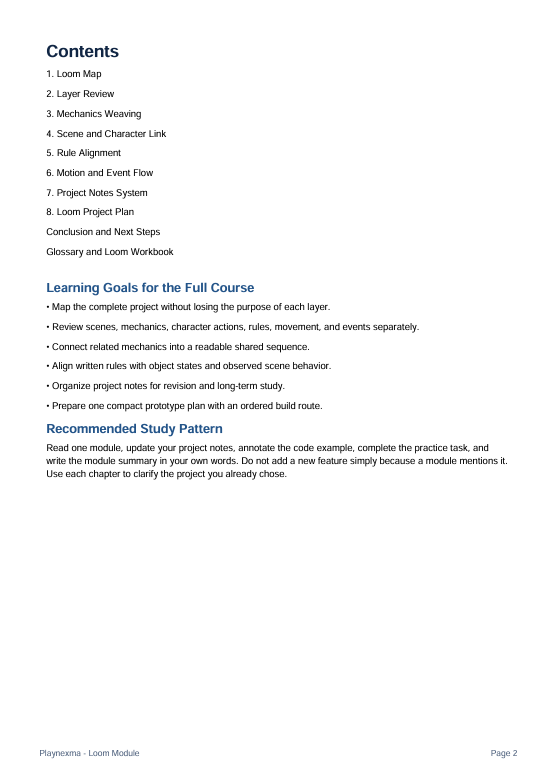
- Module 1: Loom Map — how to create a general project map with idea, scenes, mechanics, characters, rules, and events.
- Module 2: Layer Review — how to review each project layer separately and understand whether it supports the main learning task.
- Module 3: Mechanics Weaving — how to combine several mechanics so they do not conflict with one another.
- Module 4: Scene and Character Link — how to connect a character with the scene, route, objects, and interaction rules.
- Module 5: Rule Alignment — how to check whether rules match player actions, conditions, and events.
- Module 6: Motion and Event Flow — how to combine movement, pace, events, reactions, and state changes in one chain.
- Module 7: Project Notes System — how to organize notes, maps, tables, and diagrams for the final learning plan.
- Module 8: Loom Project Plan — how to prepare a complete learning prototype plan with all key parts.
4. Who Is This For?
✅ A good fit if you...
- have already worked with several game development topics;
- have a learning project with mechanics, scenes, rules, or characters;
- want to bring different project parts into one system;
- like working with maps, diagrams, tables, and structural notes;
- want to better see how idea, scene, movement, events, and rules support one another.
❌ Not for you if...
- you are only getting familiar with game development;
- you are looking for a short introduction without deeper structural work;
- you do not want to work with notes, diagrams, and project review;
- you expect a large finished project without your own practical work;
- you want to study only one separate topic without connection to other parts.
5. What You’ll Learn
- how to create a general map for a learning game project;
- how to combine scenes, mechanics, characters, movement, and rules;
- how to find fragments that do not support the main idea;
- how to describe links between player actions, events, and system reactions;
- how to review a project through separate layers;
- how to create structural notes for further work;
- how to prepare a learning prototype plan with several interactions;
- how to form a final diagram for the full Playnexma learning line.
6. Learning Markers
After completing Loom Module, you should have a complete map of a learning game project with marked scenes, mechanics, characters, rules, movement, and events. You will be able to explain how different project parts connect with one another and what role each element plays. You will also prepare a final prototype plan that can be used as a base for further learning steps. The result depends on careful work with modules, your own examples, diagrams, and practical tasks.
7. Terms and Support
Loom Module includes paid learning materials, so it is worth reviewing the tier description, module list, and learning goals before checkout. If technical questions appear after purchase while receiving the materials or using the course page, you can contact the Playnexma team within 30 days. We will review the request according to the store terms and help with the next steps. All requests are handled within the service rules, course description, and learning materials.
8. Certificates
After finishing Loom Module, the learner may receive a certificate connected with final learning project planning and combining its main parts.
Are Playnexma courses suitable for beginners?
Are Playnexma courses suitable for beginners?
Yes, some courses are created for learners who are just getting familiar with game development. Each tier includes a level description so you can choose materials that match your current experience.
What is included in the learning materials?
What is included in the learning materials?
Depending on the tier, the materials may include modules, practical tasks, examples of game project structure, mechanics explanations, working notes, and additional learning resources.
Can I study at my own pace?
Can I study at my own pace?
Yes, the materials are prepared so you can move through them in your own rhythm. You can return to topics, review examples, and repeat practical tasks.
Share